Scrapus
Web monitoring for the Turkish Pharmacists' Association (TEB). It finds banned medicine listings on online marketplaces and sends them to TEB's systems.
60,000
records processed per day for TEB, on average
90%
precision and recall for lead qualification, approximately, as reported in the Frontiers paper
0.77 to 0.92
extraction F1 with transformer NLP, reported in the paper
Problem
Banned medicines are sold on online marketplaces every day. New listings appear faster than people can check them. TEB needed a system that finds them and sends them into its own tools, without a person watching the pipeline.
What I built
- The whole pipeline, end to end: collection, cleaning, LLM-based classification and enrichment, and API delivery.
- LLM agents with retrieval (RAG) over a domain corpus. The model sees the listing and the relevant reference entries before it decides.
- Delivery through an API, so flagged records arrive in the client’s systems and not in a spreadsheet.
The pipeline runs at about 60,000 records a day with minimal maintenance.
From one client to a product
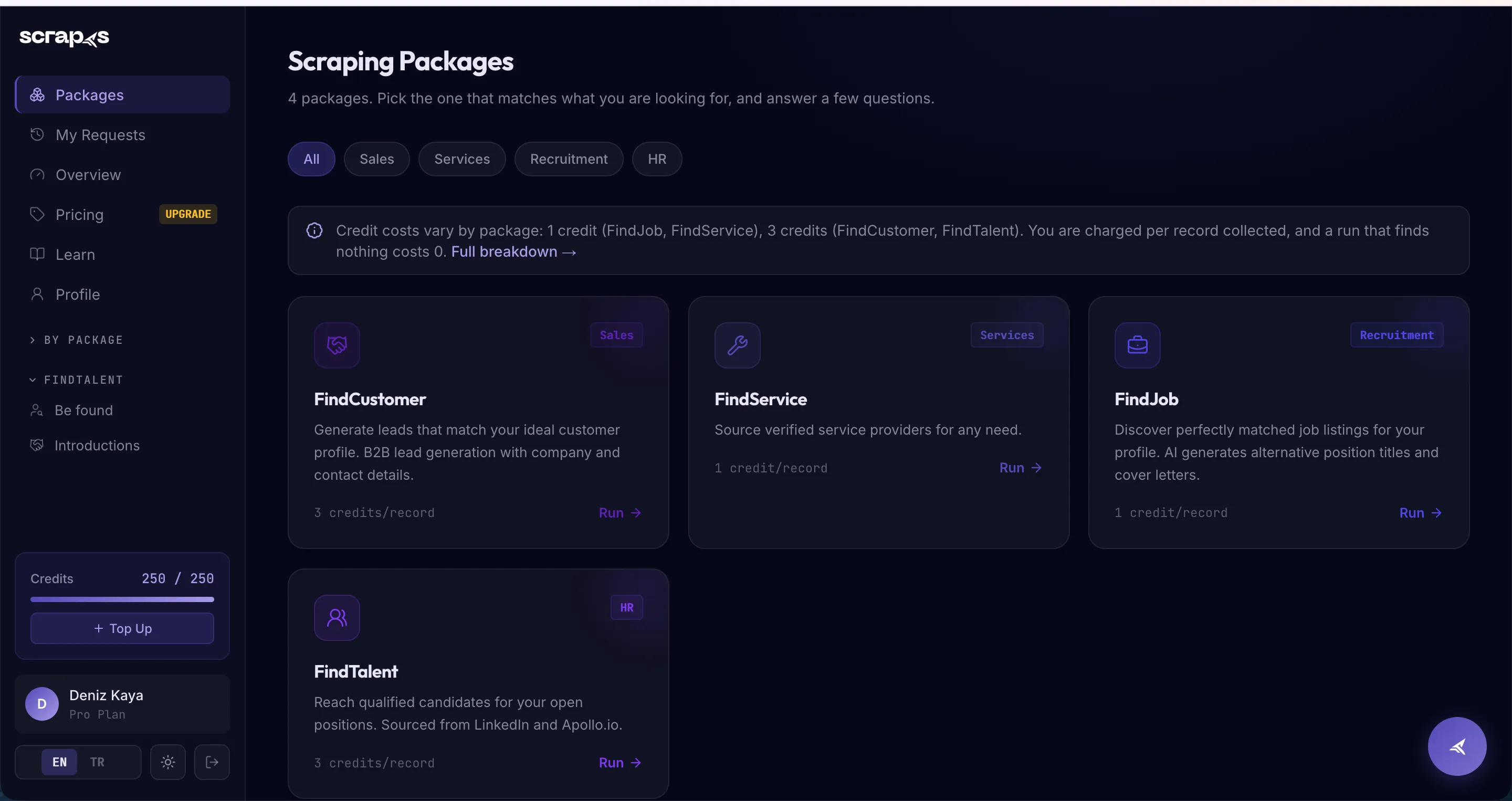
The same engine now powers a general B2B data product with four packages: FindCustomer, FindService, FindJob and FindTalent. Users pay per record collected. A run that finds nothing costs nothing. The approach is described in a paper in Frontiers in Artificial Intelligence (2025). The FindJob agent is described in a separate D3AI paper.
What I would measure next
Cost per thousand records, accuracy against a labelled sample, and drift over time. This is the topic of a paper in preparation.